
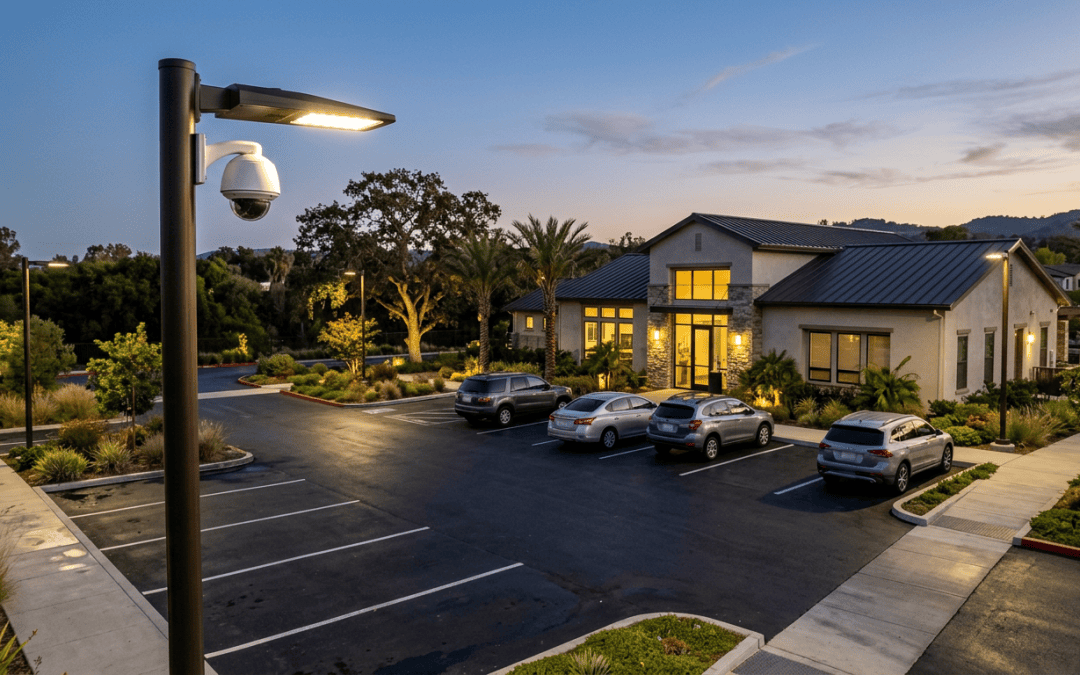
Effective HOA perimeter security pairs targeted LED security lighting with strategic camera placement at gates, clubhouses, and vehicle lanes. High-output illumination eliminates dark zones and enables optical sensors to capture clear vehicle and visitor details.
Key Takeaways
- Pairing commercial LED illumination with optical surveillance sensors allows cameras to maintain color recording mode longer, capturing vital descriptive details.
- Dedicated License Plate Recognition (LPR) cameras placed at entry and exit gates must be positioned at shallow horizontal and vertical angles to avoid headlight washout.
- California Title 24 outdoor lighting standards require energy-efficient LED fixtures, automated astronomical time clocks, and motion sensing controls.
- Integrating security lighting, access gates, and camera feeds creates a layered security strategy that protects shared community amenities and common areas.
The Security Challenges of Multi-Housing and HOA Communities
Homeowners association (HOA) boards, property managers, and community directors face unique security responsibilities. Sprawling residential communities feature multiple vehicle entry gates, pedestrian access paths, shared parking structures, swimming pool clubhouses, and recreational facilities spread across wide acreage.
When security incidents occur—such as package theft, vehicle vandalism, or unauthorized clubhouse use—community boards frequently discover that existing cameras recorded blurry, unusable footage. In most cases, the failure is not the camera resolution; it is poor camera placement combined with inadequate ambient lighting.
A successful HOA security deployment requires a unified physical design where exterior lighting and video surveillance operate as complementary systems to secure property perimeters and community common areas.
The Relationship Between Commercial Lighting and Camera Performance
Surveillance cameras require photons to produce an image. When lighting levels drop below a sensor’s minimum lux threshold, commercial cameras automatically switch from full-color daylight mode to black-and-white night mode using integrated infrared (IR) LEDs.
While infrared illumination provides visibility in complete darkness, it presents distinct operational limitations for community security:
- Loss of Color Evidence: Infrared recording produces monochrome footage, stripping away critical identification evidence such as vehicle color, clothing color, and hair color.
- Infrared Flare and Insect Reflection: Built-in IR illuminators attract night-flying insects, spiders, and moisture droplets, triggering constant motion detection alerts and obscuring camera lenses.
- Limited Optical Range: Integrated camera IR beams illuminate the center of a scene while leaving the perimeter in darkness.
Upgrading perimeter fixtures with commercial-grade security lighting solves this issue. High-efficiency LED luminaires provide broad, even illumination across community roadways and parking structures. Maintaining adequate foot-candle levels allows camera sensors to stay in full-color recording mode throughout the night, capturing crisp, actionable video evidence.
Strategic Camera Placement for HOA Perimeters and Access Gates
Camera placement requires balancing broad situational awareness with high-resolution identification. Placing a single wide-angle camera high on a clubhouse corner provides a general overview of the grounds but lacks the pixel density needed to identify faces or license plates.
Our engineering team designs HOA camera layouts around specific functional zones:
- Vehicle Entry and Exit Gates: Dedicated License Plate Recognition (LPR) cameras should be mounted at bumper height (3 to 5 feet) with a horizontal angle of less than 30 degrees to the vehicle approach lane. Specialized fast-shutter lenses overcome headlight glare to record reflective plate characters day and night.
- Clubhouses, Pool Areas, and Fitness Centers: Vandal-resistant dome cameras positioned at doorways and pedestrian gates capture clear facial images of individuals entering shared amenities.
- Guest Parking Bays and Mail Kiosks: Wide-angle cameras mounted on light poles 12 to 15 feet above the ground provide complete coverage across parking stalls and parcel lockers.
Complying with California Title 24 Lighting Regulations
Upgrading outdoor security lighting in California requires strict compliance with the California Energy Code (Title 24, Part 6). These regulations mandate energy conservation, dark-sky light pollution reduction, and automated control requirements for all commercial and multi-family outdoor lighting installations.
Under Title 24, outdoor luminaires rated above 25 Watts must feature high-efficiency LED drivers and automated daylight shut-off controls via photocells or astronomical time switches. Additionally, fixtures illuminating walkways, parking lots, and building perimeters must incorporate multi-level motion sensors that reduce fixture power by 50 to 70 percent during unoccupied hours, ramping up to 100 percent brightness instantly when motion is detected.
Working with a licensed contractor ensures that lighting retrofits deliver powerful illumination for security cameras while meeting state energy codes and municipal lighting ordinances.
Not sure what your site needs? Our team is happy to talk it through. You can schedule a complimentary security evaluation with our project engineers to discuss your HOA requirements.
Structured Wiring and Long-Distance Perimeter Cabling
Distributing video data and power across expansive HOA properties presents significant physical infrastructure hurdles. Clubhouse buildings, security gates, and perimeter light poles are frequently separated by hundreds of feet of landscaped turf, concrete sidewalks, and asphalt roadways.
While standard copper network cables cannot exceed 328 feet, our team installs dedicated single-mode fiber optic links inside underground conduits to connect remote gate cameras directly back to the central recording headend. For locations where trenching across existing concrete is cost-prohibitive, point-to-point wireless bridges provide secure, encrypted high-throughput data transmission between buildings and light poles.
Partnering with a Licensed California Security Contractor
HOA boards must manage fiduciary responsibility and ensure that all community infrastructure investments comply with California safety standards, electrical codes, and privacy laws. Working with an unlicensed installer exposes the association to legal liability and unpermitted electrical work.
Pro-Techs operates as a licensed C-10 Electrical Contractor (CA C-10 License 951006 | CA ACO License 8012 | AZ Specialty Commercial C-11 Electrical ROC#357406). We specialize in commercial security lighting conversions, conduit trenching, low-voltage power distribution, and complete video surveillance systems for multi-housing properties across Northern California and the Bay Area.
Our team works closely with property management companies and HOA boards to deliver turn-key security systems with factory warranties, clean installations, and responsive local support.
Frequently Asked Questions
How does security lighting improve camera video quality?
Adequate ambient lighting allows camera optical sensors to stay in color mode rather than switching to monochrome infrared, preserving vital identification details such as vehicle colors, clothing colors, and skin tones.
Can HOA cameras legally record public sidewalks and streets?
Under California law, video cameras may record public areas, roadways, and shared community spaces where individuals have no reasonable expectation of privacy. Cameras must never be angled to view inside residential windows, patios, or private backyards.
What is the difference between an overview camera and a license plate camera?
An overview camera uses a wide-angle lens to monitor large areas like parking lots. A License Plate Recognition (LPR) camera uses a telephoto lens, high shutter speed, and glare-reduction filters to focus specifically on reflective vehicle license plates.
How do motion-controlled LED security lights work with cameras?
Title 24-compliant LED fixtures operate at a low ambient level during quiet hours and switch to full brightness when movement is detected, providing high-contrast illumination that assists cameras while deterring unauthorized visitors.
What cabling is recommended for cameras located at distant entrance gates?
For cameras located more than 328 feet from the main recording closet, dedicated single-mode fiber optic cabling or point-to-point wireless bridges are used to deliver stable, high-bandwidth video data without signal loss.
Planning Your Next Step
Enhancing security across an HOA community requires evaluating daily vehicle patterns, pedestrian traffic, and lighting dark spots across all shared property assets. Designing a coordinated lighting and camera layout before purchasing hardware ensures maximum coverage and lasting value for your community.
If your HOA board or property management team is planning a security lighting upgrade or camera installation in California, contact our team. Schedule a complimentary security evaluation or call us at (800) 828-0652 to review your property with our experienced project engineers.
