
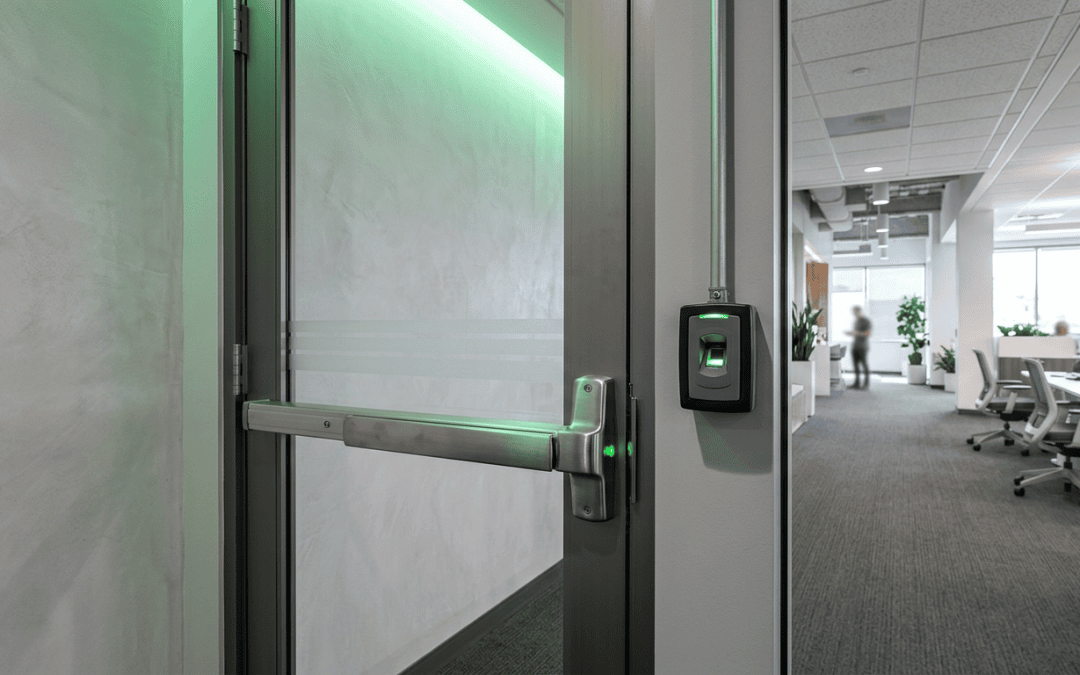
Commercial access control systems must maintain uninhibited egress at all times under California building and fire codes. Electrified hardware, motion sensors, and emergency push bars must release instantly during an alarm or power outage to protect building occupants.
Key Takeaways
- California Building Code Title 24 and NFPA 101 require all commercial exit doors to allow free unlatching with a single unlocking motion.
- Electromagnetic locks require fail-safe power configurations and dedicated secondary release devices to guarantee immediate egress during emergency power losses.
- Integrating access control panels with fire alarm control panels (FACP) ensures automatic door unlocking across primary exit pathways.
- Working with a licensed C-10 Electrical Contractor ensures all low-voltage power supplies, plenum cabling, and panic hardware meet local municipal code enforcement.
Understanding California Life Safety and Free Egress Mandates
The primary principle governing access control installations across California is that security must never compromise life safety. While exterior locking hardware prevents unauthorized individuals from entering a commercial facility, anyone inside the building must be able to exit without special knowledge, keys, or physical effort.
Under the California Building Code (CBC) Chapter 10 and NFPA 101 Life Safety Code, commercial exit doors must operate with a single unlocking motion. Installing locks that require a person to turn a deadbolt while simultaneously depressing a lever handle creates a severe code violation. During a fire, smoke contamination, or power loss, occupants must be able to push open an exit door in seconds.
When our engineers conduct an initial facility walkthrough, we evaluate door swing directions, occupancy loads, and designated egress paths. Commercial office suites, educational spaces, and industrial warehouses each carry distinct occupancy thresholds that dictate whether standard electrified lever locks or dedicated panic exit hardware are legally required.
Electrified Locks: Fail-Safe vs Fail-Secure Mechanisms
Selecting the correct locking hardware mechanism is critical for both code compliance and physical facility security. Commercial access hardware operates in one of two fundamental electrical configurations: fail-safe or fail-secure.
- Fail-Safe Hardware: Requires continuous electrical power to stay locked. When power is interrupted, either by a building outage or a fire alarm relay, the lock automatically unlocks. Electromagnetic locks (maglocks) are inherently fail-safe and are commonly deployed on interior glass doors and emergency stairwells.
- Fail-Secure Hardware: Requires electrical power to unlock. When power is lost, the exterior trim remains securely locked against outside entry, but mechanical crash bars or interior levers still provide free manual egress from within the room. Electrified mortise locks and cylindrical locksets typically operate in fail-secure mode.
Deploying fail-secure electrified strikes on perimeter doors allows a business to maintain exterior security during power outages while ensuring full compliance with California emergency egress standards.
Code Requirements for Electromagnetic Locking Systems
Because electromagnetic locks use magnetic force to secure doors without mechanical latches, California building codes enforce strict redundant safety measures for their installation. Maglocks must never trap an occupant inside a room during an emergency.
CBC Section 1010.2.11 outlines specific requirements for sensor-release and switch-release door hardware:
- PIR Exit Sensors: A passive infrared motion sensor must be mounted on the egress side above the door frame to detect approaching occupants and automatically cut power to the magnetic lock.
- Manual Pneumatic Release Buttons: A secondary manual emergency push button labeled “PUSH TO EXIT” must be installed adjacent to the door frame, mounted between 40 and 48 inches above the floor. This button must operate on an independent pneumatic timer that cuts power to the magnet for at least 30 seconds.
- Fire Alarm Relay Tie-In: The access power supply must interface directly with the main Fire Alarm Control Panel (FACP) to drop power to all electromagnetic locks immediately upon fire alarm activation.
- Loss of Power Release: Any total failure of the electrical power supply must automatically drop magnetic holding force, unlocking the door.
Integrating Access Control Panels with Fire Alarm Systems
Modern commercial buildings rely on central access control panels to manage door schedules, reader inputs, and credential databases. Integrating these panels with the building fire alarm system is an essential step in every code-compliant access installation.
Low-voltage power supply distribution boards feature dedicated fire alarm interface (FAI) input terminals. When the municipal fire alarm activates, the FACP sends a contact closure signal to the access power distribution modules. This signal cuts 12VDC or 24VDC operating power to all fail-safe locks across designated egress corridors, ensuring clear evacuation routes for first responders and building tenants.
Our team installs monitored power distribution enclosures with battery backup and status supervision. This design ensures that auxiliary security power remains clean, stable, and capable of operating card readers during momentary voltage drops without interfering with emergency life-safety protocols.
Not sure what your site needs? Our team is happy to talk it through. You can schedule a complimentary security evaluation with our project engineers to discuss your facility requirements.
ADA Compliance and Low-Energy Automatic Door Operators
Commercial access control designs must also adhere to Title III of the Americans with Disabilities Act (ADA) and California Title 24 accessibility standards. These regulations dictate mounting heights, operating reach ranges, and physical force requirements for door hardware.
Wall-mounted card readers, biometric scanners, and keypads must be installed between 34 and 48 inches above the finished floor to remain accessible to wheelchair users. In high-traffic commercial vestibules, integrating card credentials with low-energy automatic door operators enables smooth, hands-free entry for employees and visitors with physical disabilities.
When an authorized mobile credential or proximity card is scanned, the access control controller signals the automatic door actuator to swing the door open smoothly, maintaining the required hold-open dwell time before re-latching securely.
Working with a Licensed C-10 Electrical Contractor
Installing commercial electrified door hardware requires deep expertise in electrical circuitry, door framing geometry, and regional building codes. Improperly wired power supplies or unapproved lock modifications can result in failed municipal fire inspections and severe life-safety hazards.
Pro-Techs operates as a licensed C-10 Electrical Contractor (CA C-10 License 951006 | CA ACO License 8012 | AZ Specialty Commercial C-11 Electrical ROC#357406). Our certified technicians ensure that all conduit raceways, plenum-rated cabling runs, power supplies, and access control systems meet strict state building regulations and manufacturer specifications.
We work directly with commercial facility directors, general contractors, and local Authorities Having Jurisdiction (AHJ) to verify that all door hardware schedules pass municipal life safety and fire code reviews before project sign-off.
Frequently Asked Questions
Can access control doors be locked from the inside?
Under California building and fire codes, commercial doors in designated egress paths must never be locked from the inside. Occupants must be able to open the door instantly for emergency exit without using keys, credentials, or special tools.
What happens to access control doors during a power failure?
Fail-safe locks, such as electromagnetic locks, automatically unlock when power is lost. Fail-secure locks remain locked from the outside to protect property, but mechanical interior handles or crash bars continue to allow unrestricted exit from inside.
Do magnetic locks require approval from local fire marshals?
Yes. Installing electromagnetic locks in commercial facilities typically requires submittal of door hardware schedules, electrical schematics, and an on-site inspection by the local fire marshal or building official to verify emergency release compliance.
What is the difference between electrified strikes and electrified mortise locks?
An electric strike replaces the standard stationary strike plate in the door frame, allowing the latch bolt to release electrically. An electrified mortise lock houses the electrical locking mechanism directly inside the door body, providing superior physical strength and integrated monitoring switches.
How does access control integrate with commercial video surveillance?
Access control panels can be integrated with commercial camera networks to visually verify badge usage, record video clips during unauthorized access attempts, and improve overall facility oversight.
Planning Your Next Step
Upgrading your commercial facility with modern access control requires balancing perimeter protection with strict California life safety and emergency egress standards. Reviewing your door schedules, locking hardware, and electrical power distribution early in the planning process prevents costly remodeling delays.
If you are planning an access control upgrade or need a code-compliance review for your California property, reach out to our team. Schedule a complimentary security evaluation or call us at (800) 828-0652 to discuss your project with our experienced engineers.
